Lichess vs Chess.com rating: what your Lichess rating is on Chess.com
Every week someone asks "I’m 1500 on Lichess, what’s that on Chess.com?", and the answers are a self-reported survey or a guess. I wanted the real numbers, so I looked for the same people, active on both sites and playing their best on both, and pulled their ratings from the two public APIs.
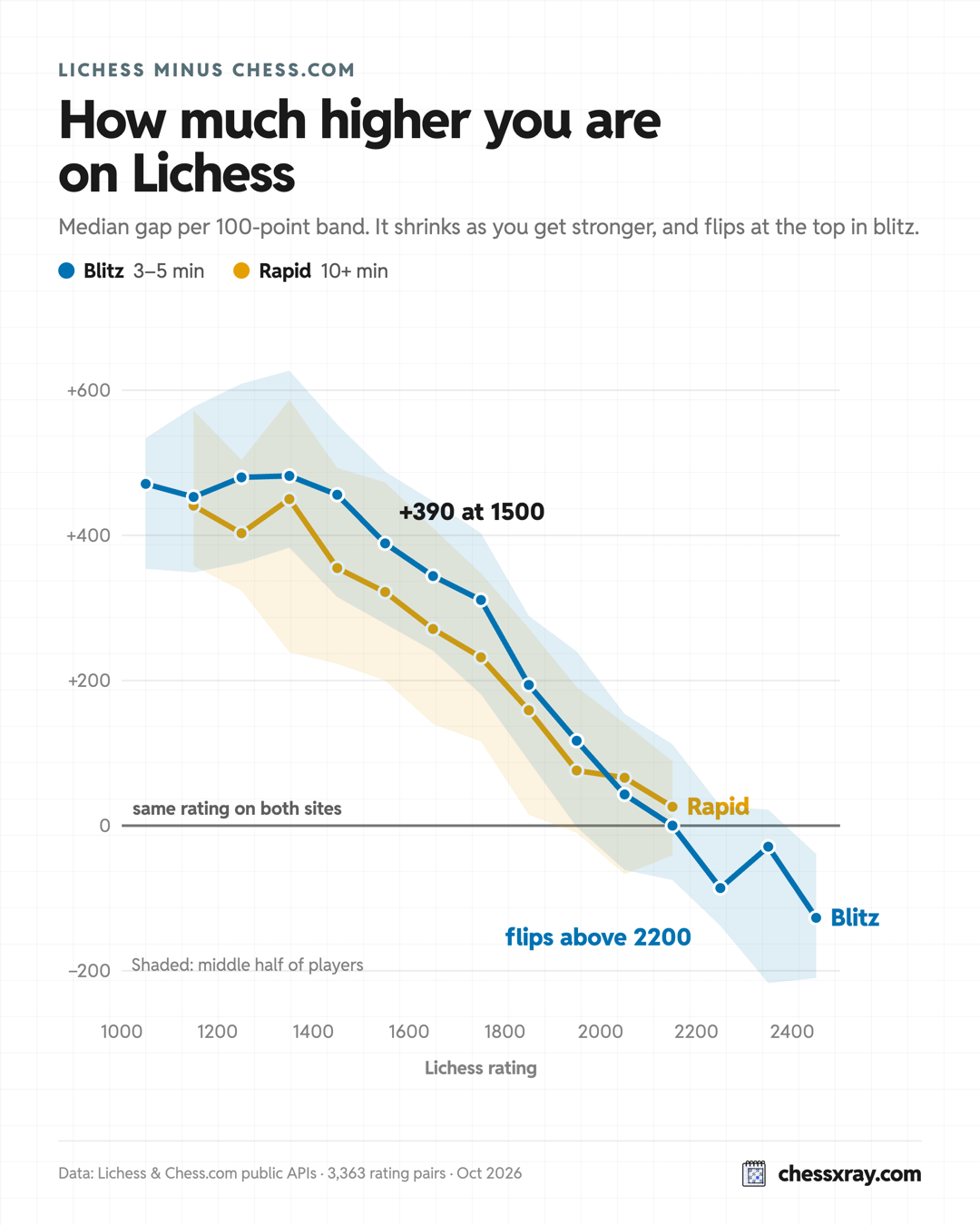
A blitz player rated 1500-1599 on Lichess is typically around 1160 on Chess.com, about 390 points lower. In rapid it is around 1230, about 330 lower. Right at 1500 (1450 to 1549), it is closer to 1080 in blitz and 1135 in rapid. The gap gets smaller as players get stronger, and in blitz it flips above 2200.
The numbers
- Almost everyone is rated higher on Lichess. The gap shrinks as you climb the ladder: in blitz, about 485 points at 1300-1399, 395 at 1500-1599, 310 at 1700-1799 and 45 at 2000-2099. Each gap is the median of every player’s own difference.
- In blitz the gap closes around 2100. At 2200-2299, players are about 70 points higher on Chess.com.
- Below 2000 the rapid gap is smaller than the blitz gap. At 1400-1499 it is 365 points in rapid and 450 in blitz.
- These are medians. Among players with the same Lichess rating, the middle half spreads over about 200 Chess.com points in blitz, and more in rapid.
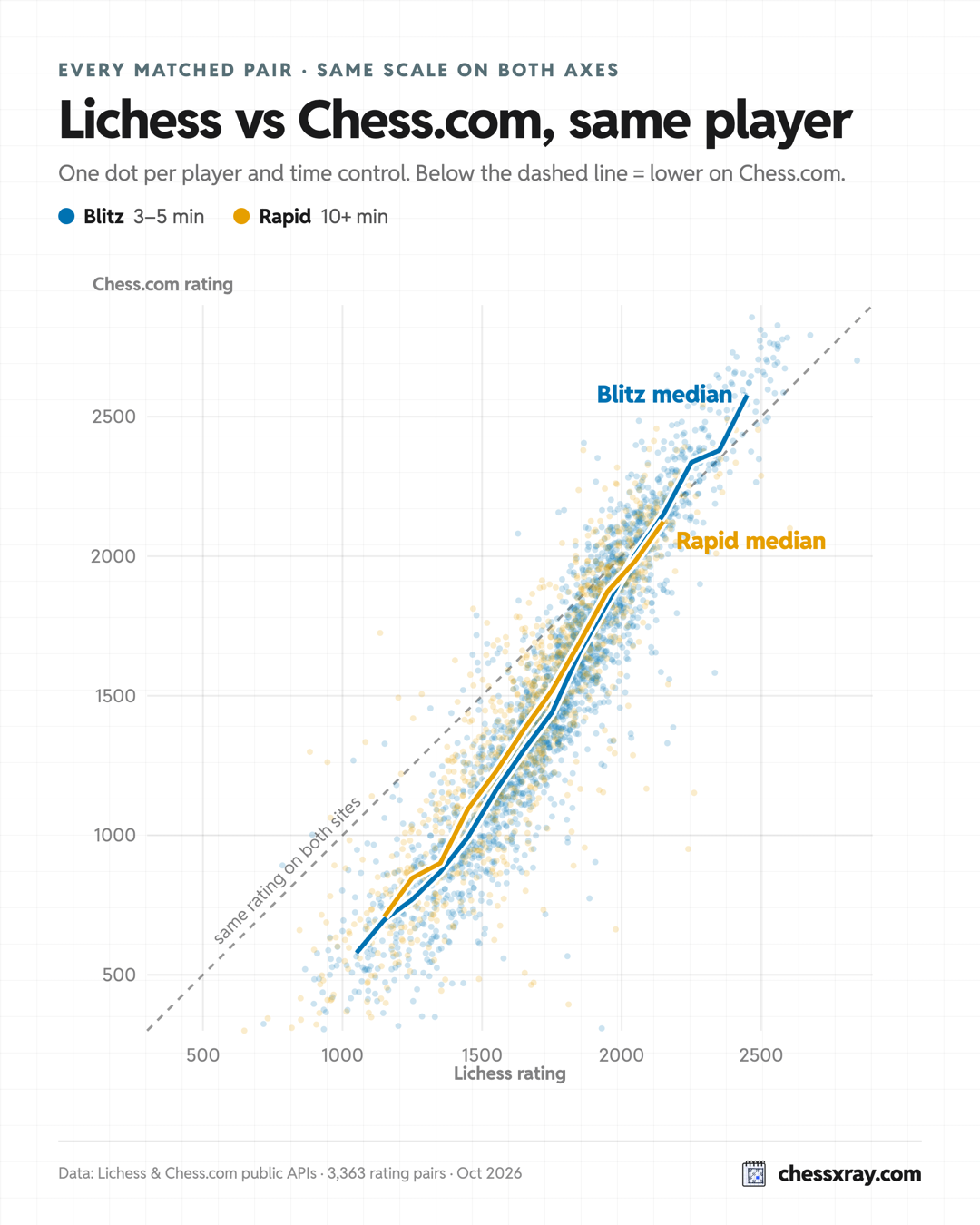
Why the gap shrinks
Chess.com spreads the same players over a wider range. In blitz, two thirds of them are within about 330 points of the average on Lichess, and within about 535 points on Chess.com. In rapid it is 310 and 480. Weaker players end up much lower on Chess.com, stronger players catch up, and the two scales cross around 2200.
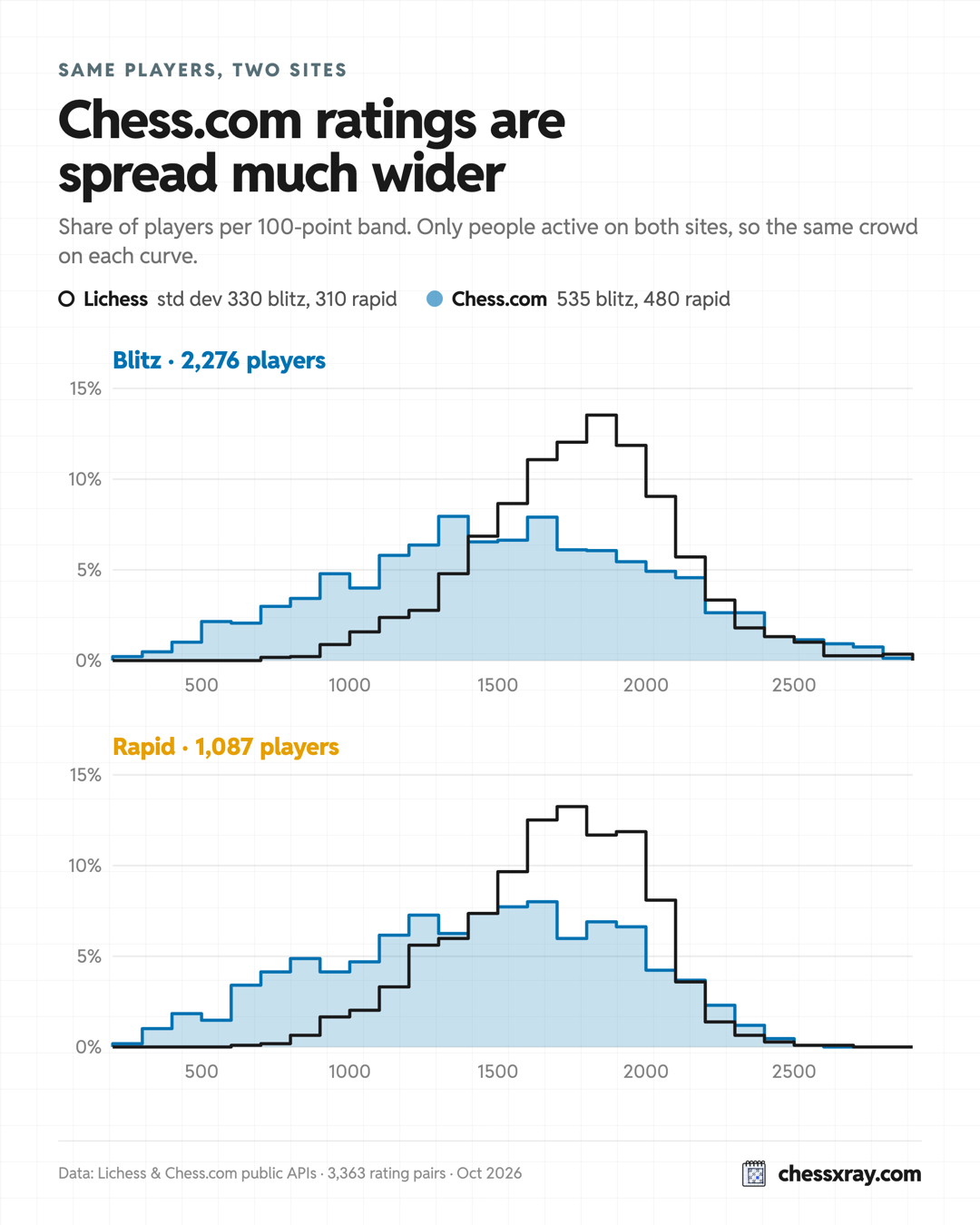
My guess is the starting rating. Lichess starts every new account at 1500. Chess.com starts you anywhere from 400 to 2000, depending on the level you pick when you sign up. The data shows the wider spread but cannot tell what causes it.
From your Lichess rating to Chess.com
| Lichess | Chess.com blitz | Chess.com rapid |
|---|---|---|
| 1000-1099 | 579 | - |
| 1100-1199 | 697 | 709 |
| 1200-1299 | 770 | 847 |
| 1300-1399 | 868 | 900 |
| 1400-1499 | 994 | 1095 |
| 1500-1599 | 1161 | 1228 |
| 1600-1699 | 1306 | 1379 |
| 1700-1799 | 1439 | 1518 |
| 1800-1899 | 1656 | 1691 |
| 1900-1999 | 1833 | 1874 |
| 2000-2099 | 2007 | 1984 |
| 2100-2199 | 2150 | 2124 |
| 2200-2299 | 2336 | - |
| 2300-2399 | 2379 | - |
| 2400-2499 | 2577 | - |
From your Chess.com rating to Lichess
This table is not the first one read backwards. If you pick players by their Lichess rating, the ones far from the average are partly there by luck, so their Chess.com rating tends to sit closer to the average. The same happens in the other direction. Use the table that starts from the rating you know.
| Chess.com | Lichess blitz | Lichess rapid |
|---|---|---|
| 500-599 | 1113 | - |
| 600-699 | 1260 | 1180 |
| 700-799 | 1327 | 1271 |
| 800-899 | 1372 | 1294 |
| 900-999 | 1447 | 1456 |
| 1000-1099 | 1504 | 1438 |
| 1100-1199 | 1567 | 1541 |
| 1200-1299 | 1612 | 1592 |
| 1300-1399 | 1700 | 1675 |
| 1400-1499 | 1734 | 1696 |
| 1500-1599 | 1801 | 1758 |
| 1600-1699 | 1850 | 1792 |
| 1700-1799 | 1882 | 1847 |
| 1800-1899 | 1956 | 1917 |
| 1900-1999 | 1988 | 1984 |
| 2000-2099 | 2055 | 2027 |
| 2100-2199 | 2108 | 2104 |
| 2200-2299 | 2169 | - |
| 2300-2399 | 2264 | - |
| 2400-2499 | 2297 | - |
How I measured it
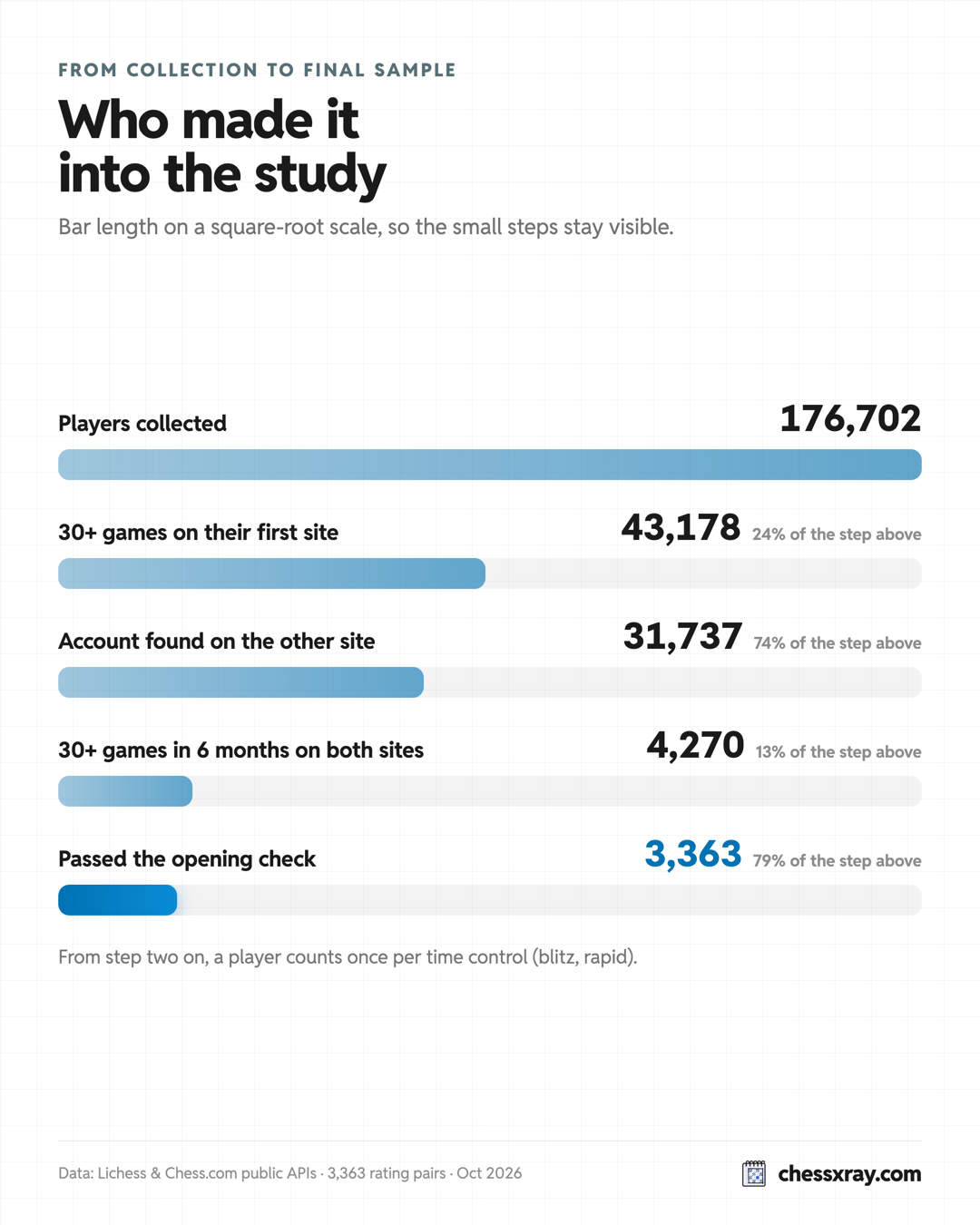
- I started from about 30,000 active Lichess players found in blitz and rapid arenas. To cover the Chess.com side too, I took about 147,000 opponents from their recent Chess.com games and looked them up on Lichess. About 27,000 had an account there. This second pass gives 45% of the final pairs, and the Chess.com to Lichess table depends on it.
- Two accounts count as the same person when one profile links to the other, or when the username is the same on both sites and passes the opening check below. If the other account links to someone else, I drop the pair. A player found in both passes counts once.
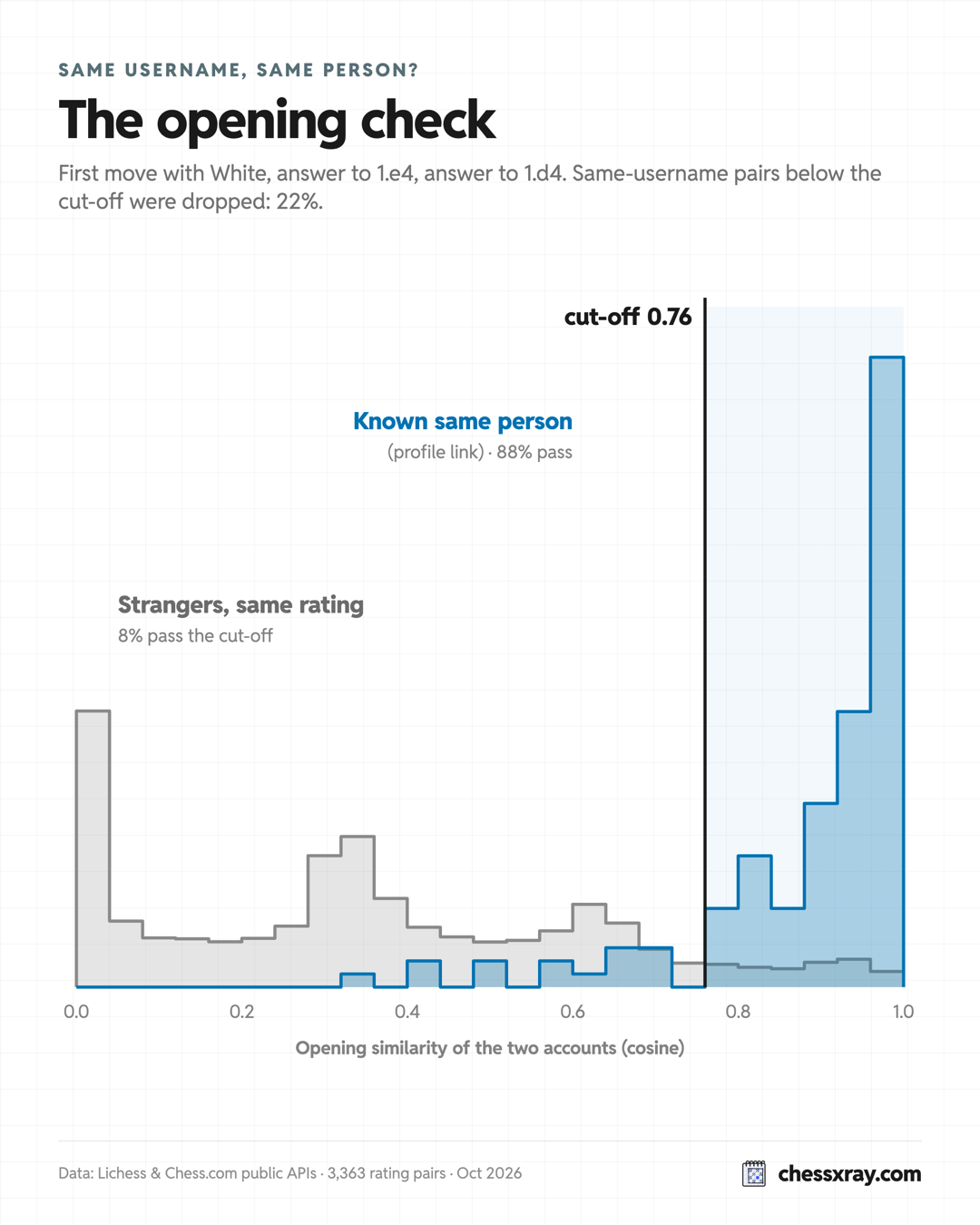
- "magnus123" on Lichess is not always "magnus123" on Chess.com, so I compare openings. For each account I take its first move with White, its answer to 1.e4 and its answer to 1.d4, from its own games. People are creatures of habit: the same person plays almost the same openings on both sites, two strangers usually don’t. I set the threshold on 119 pairs known to be the same person through a profile link, against random players of the same rating. It keeps 88% of the known pairs and lets through 8% of the random ones. Separate thresholds for players under 1200, 1200-1800 and over 1800 landed on the same value. 22% of same-username pairs failed and were dropped.
- A player counts only with more than 30 games in that time control over the last 6 months, on both sites. I use their average rating over those games, so one good or bad week does not move it. Provisional ratings and closed accounts are left out.
- That leaves 3,363 rating pairs, 2,276 in blitz and 1,087 in rapid. The tables give the median per 100-point band and leave out bands with fewer than 30 players.
All of this comes from two public APIs, and both are good. Chess.com gets a lot of criticism, but its public API needs no key, no account and no payment. Lichess is the same: open, free, no token for public data, and its whole game database is open too.
- Collecting 30,000 Lichess players from arenas took about 40 minutes.
- On Chess.com, checking accounts and downloading recent games took 96,087 requests over about 20 hours, with zero "slow down" errors (HTTP 429). I sent one request at a time.
- Lichess game downloads are heavier: over 5,248 requests, Lichess asked me to slow down 74 times, and I paused each time. Fair enough for a free service run by a non-profit.
So thank you Lichess and thank you Chess.com. I only publish aggregates and name no player.
What costs you points
If you want to know which mistakes cost you rating points, Chess X-Ray reads your recent Lichess or Chess.com games and finds the 10 mistakes you repeat most, each turned into a lesson on the position where you made it.